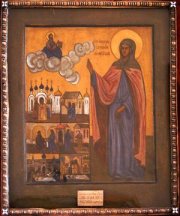
Juliana of Lazarevo and Remembrance

As an archivist, I was, and still am, fascinated with how people are remembered in the future. A few years ago, I had the unique privilege of working with a large mass of personal & professional papers from a single influential family in a small town. Their ancestors had lived in the same house for over 140 years and their attic was a proverbial treasure trove. They didn’t throw away anything that pertained to themselves – they just stashed it upstairs! I discovered the intricacies of relationships, like a play unfolding before me in the scraps of silverfish nibbled paper. Local historians know their cast of characters but we often do not understand how they behaved towards each other or what they liked to eat. Finding these tidbits of memories was like panning for gold in the dusty boxes from an antebellum brick house on Main Street.

Through the endless sorting of papers, I was able to piece together the life of a young woman, who died at age 29, a person whom we only knew from her name and two dates on a headstone in the family plot. She had a full life – was able to attend a finishing school for ladies in the 1870’s, taught in local grade schools, enjoyed reading the classics and current literature, and went on excursions with her friends. Along with her letters and essay books, the family donated a trunk of clothing, the unpacking of which was a somber but thrilling chore for a material culture historian. In the trunk were the black and grey shaded accouterments of Victorian mourning garb from 1882, the year Miss Emma died. The expense shown in the jet buttons, the parasol, the silk shawls, the custom dresses, was a visible sign to the world of how bereaved the family felt at her loss.

When handling her personal effects, I often reflected on the nature of the survival of memory, of whether Miss Emma had any idea the contents of her writing box would be read three generations later. The remarkable gift of love and stability – or some may argue – a lazy neglect from her future relations gave us a peek into a rare story, an ordinary life. Ordinariness is easily lost. Peasant linen clothing was worn to shreds and then eventually turned into paper. Wooden houses burn down. Small traditions die out with families. The real struggle for social historians is finding the examples and explanations for why a thing or an image exists. We have to accept some questions may never be answered.

When teaching the girls in my parish about women saints, I wanted to include an ‘every day’ saint – one who, from outward appearances, was ordinary to her time and place, but lived a holy life nonetheless. When I read about St. Juliana of Lazarevo, I found a saint, who, but for the loving attention of her son, would be unknown to us today. She was a pious soul from early childhood, being orphaned and left with relatives who did not understand her ways, she kept a practical faith. She cared for the sick and sewed clothing and burial shrouds for the poor. A fellow nobleman fell in love with her and brought her into his parents’ household. Juliana quickly showed her skill in managing a burgeoning home, having given birth to ten sons and three daughters. Her in-laws turned over the keys to her for the estate.

Juliana suffered deep sorrow when six of her children died from plague. Her desire was to retire from the world to the monastery. Her husband, Yuri, encouraged her to stay with the family and see their remaining children grow into adulthood. So, Juliana stayed at Murom and re-doubled her ascetic efforts. After her husband died, Juliana did not go to a monastery but decided to stay in the world, living in poverty because she gave away her inheritance to the poor. Even during famine, she made sure to have bread to give to beggars which was, “sweeter than anything they had ever tasted.” Several years after her death, Juliana’s relics were found incorrupt and streamed myrrh that brought healing to many.

There are several themes I could have taught from St. Juliana’s life – her practical holiness, her obedience to the path of salvation within marriage & family life, her charitableness from a position of inherited wealth – all of which are foundational lessons. What I found most fascinating is the gift of remembrance St. Juliana received within the life of the Church as an otherwise unremarkable woman in her time and place. Her son, George, praised her in writing, which, at the time in early 17th century Russia, was a rare task and this writing was preserved after his death, providentially, at the time his mother’s relics were found incorrupt.

For Orthodox Christians, remembrance is the task of the living. I heard it said, that even in the darkest times of the Communist era, when no service books survived in a town, priests could rely on the grandmothers to know the liturgical prayers by heart. We have a vast family ‘attic’ of written collections in a hundred languages of saint’s lives and the liturgical functions of the Church. The akathists teach us through rhythm and song the lives of the saints. In most countries where Orthodoxy has grown, the majority of people are literate and can have access to all these materials in their native language. While the printed word ‘outsources’ memory to a certain extent, it has never replaced the inherent nature of our faith tradition, that which is taught by example, what is sung by the elders and repeated by the young. Paper, vellum, and stone are trustworthy to an extent, but only so far as the people who value them. Living in the Church of the martyrs, we know all too dearly how quickly the elements burn. Our strength in Christ is our collective memories, to keep the Word alive in speech and deed, that no man or element can destroy.

Links:

https://orthodoxwiki.org/Juliana_of_Lazarevo

https://stjulianalazarevo.org/the_saints_life.html


Saint Lydia and Influence

st.lydiaWhat makes for an influential life? Why do you listen to certain people and not others? What sort of human qualities do you admire? These questions have occupied philosophers and religious people for all of civilization. How we define social power, outside of the brute strength of the sword, depends a great deal on when and where we live. There are a few universals: wealth, birth, physical appearance, sex, and character are the five main determinations of influence. For most societies, who your parents were and how much money or property you inherited delimited your social circle and how you could operate in that circle.

Lydia of Philippi had a rather unique standing in her time and place, as a woman and as a merchant. She was mentioned as being a ‘seller of purple cloth’ in the Book of Acts, who had settled in Philippi. Thyatira, in what is now Turkey, was the center for purple cloth production. Tyrian purple was once known in the Grecco-Roman world as is Belgian chocolate or Swiss watches today. Creating purple dye was a rare and labor intensive process, using thousands of snails, that once crushed and cooked with other chemicals, created an intense color not produced through any other process. It wasn’t until the 1850’s when the first synthetic dye, aniline, was accidentally invented, that the color purple was no longer a status symbol of wealth.

Lydia must have been born or married into the trade, as with many skills, the secrets of making the perfect shade of dye was closely guarded. Being a merchant in luxury trade also granted esteem in the community. Lydia had to know the social intricacies of the wealthy and also the technicalities of what was physically possible in creating the dyed textiles. The merchant was often in the precarious position of saying, “No, we cannot provide what you want, when you want it” or “It was a bad year for snails, so the price will be much higher for wool.”

The Church remembers Lydia and her household as the first converts in Europe. Remarkable also was her being a woman of prestige, who took the risk of believing in the messiah preached and sheltering Paul after his arrest. St. Luke mentions several times in Acts when a convert had status through wealth or birth. One might view this notation as a means of adding legitimacy to the newly formed faith. “Look, so-and-so joined, therefore, we are correct.” Yet, this is not what the early Church thought. Their understanding was, “Look, this woman has taken a great risk. She heard of Christ and his Kingdom, counted the cost, and went ahead!” We all have ‘loss’ in the world for being a Christian. What St. Luke noted and what other hagiographic details take into account, with wealth, beauty, and status, is those in position of them choose to no longer use it as self-indulgent power.

Having made that choice, Lydia, and saints like her, have a second fork in the road. Do I give away my wealth? Do I stay where I live or go elsewhere to spread Gospel? Do I shun married life thus keeping virginity and beauty for Christ? Or do I stay here, keep my trade and my marriage, and build the Church? Lydia chose the latter. She was already known for her devotion to God and to prayer. She knew the influence she possessed and chose to use it for the sake of the Gospel of Christ with the people she knew already. In the epistle written a few years later to the Philippians, St. Paul recognizes the people he met as, “…my beloved and longed-for brethren, my joy and crown”. Lydia was a key role model for the believers who joined the Church, being the first to welcome St. Paul and showing hospitality.

Most of us, in varying degrees, are like St. Lydia. We stay in our professions and our towns to use what influence God has given us to love our neighbors. As Marcus Aurelius writes in his Meditations, “Anywhere you can lead your life, you can lead a good one.”  It may not be the great influence of robing governors in purple, but we each have a means to communicate through our goodness and humility to everyone we meet.

Links:

Tyrian Purple –

https://www.nytimes.com/2013/10/09/science/the-color-of-royalty-bestowed-by-science-and-snails.html

History of Thyatira –
https://en.wikipedia.org/wiki/Thyatira

More on Lydia –
https://orthodoxwiki.org/Lydia_of_Thyatira


Patron Saints

The Three Holy Generations

The major assignment I gave my middle school girls in Church School was writing a report on their patron saint, which they presented in class and before the parish at the end of the year. Like a proper teacher, I made a report form with a series of questions that would guide my students towards including the most important information about their saint. My librarian  instincts for categorization ran into a few difficulties right away. One girl has St. Michael the Archangel as her patron. She couldn’t answer when he was born or where he was buried! This made me reflect on the ideas surrounding patronage and relationships with saints. Let’s get down to the basics.

A patron saint is an intercessor in heaven for a nation, region or church, a profession, an activity, families, and for each Orthodox Christian. Patron saints of places have some sort of connection with it, either they lived or died there, preached the Gospel, performed a miracle, or had their relics interred in a church. A personal patron saint is the one for whom we are named at baptism (or chrismation) and are known in the Church when we take communion. For those of us from the Western churches, the patronage distinctions are more holistic than explicit categorizations. You could have four dozen saints just for a simple lifestyle! In my observation, most Orthodox Christians have 3-4 saints who are a central focus of their lives: personal, church, sometimes a family saint (Slava), and a regional/national identification.

There is an interesting contrast for those who were born into the Orthodox faith and for those of us who entered the Church as adults as it pertains to our patron saints. I have heard ‘cradles’ express disconnect with their patrons – as though not having a choice in the matter means they are automatically distant from this saint. “I would have picked this one! They are so much  more interesting!” Or, sadly, they are ignorant of their patron beyond just a name they say when receiving communion.

On the flip side, many converts must choose a patron because their birth name is not of Christian origin. How can we make such a major life decision – an alignment with the kingdom of God for the rest of our earthly lives! Do we just go by the day we were born, our nationality, our interests or suffering in life, or that form of holiness to which we aspire? I was providentially given three saints names at birth, though my family was not Orthodox. God knew I needed all the help I could get! Yet, when I became a catechumen, I still wrestled with accepting that St. Anna was indeed my patroness. What of others with whom I shared more life experiences?

What might give peace these situations is understanding that patronage means an abiding, unfailing love and care within Christ’s Church. Godparents might fail you at some point in time (I pray that never happens) – but not your patron saint. They will ever intercede for you, provide assistance, and guide you towards wise choices. Like any relationship, however, when you have a need, you should just ask those who love you! If you feel no connection with your saint, perhaps starting with the basics like learning their life story, how they have acted within the life of the Church since their repose, and acquiring an icon of them for your prayer corner are good actions. Beyond that, reading the akathist for your saint is both instructive and builds trust with them.

Life is about entering a story already in progress. We accept the treasury of good gifts the Holy Spirit has given us! For cradles, you were given the gifts of a heritage in the faith through your patron saint, and through your parents and godparents. For those of us who made a conscious shift to become Orthodox, we honor the myriad of ways God has directed us here.  I accept the wisdom of choices made before I was born. When choosing a patron saint, there really isn’t a ‘wrong’ way to go. As you grow in the faith, you may feel closer to another saint or a series of saints, just as you make friends with other Orthodox or others help you on an emergency basis. Your home base, however, is with your patron.

Link:
https://saintandrew.net/christiannames.html


Saint Thekla and Preaching the Gospel

St. Thekla, Equal to the Apostles

We would like to think of Thekla in our modern definitions as spunky or unconventional. The branding of materials marketed to girls likes to emphasis bravery, pioneering attitudes, and achieving the remarkable. While there is much to be lauded in teaching young women to value their intelligence and capability, this sort of “I’ll show you” message is not what we encounter in Thekla.  No, friends, being merely spunky does not get you almost martyred several times. There is a difference between being a non-conformist and embarking on the radically different. There is also a difference between trivial personal rebellious monikers (tattoos, hair color, clothing choices, piercings, etc.) and the life lived out of the desire to spread the Gospel of Jesus Christ. One thing might get you noticed for five minutes and the other will have you remembered for the ages of the Church.

Thekla was the daughter of Greek nobles from the city of Iconium, which is now in central Turkey. She was a famed local beauty and was engaged at the age of eighteen to a respectable man named Thamyris. As a young woman in the first century Greek culture, her future life was well set up.

The Apostle Paul stopped in Iconium on his way from Antioch. He stay with Onesiphoros and taught all who came to visit at his house. Thekla followed others to the house and listened at the doorway to this strange teaching. She forgot food & drink, even her family and obligations to her fiance. All she wanted was to hear more about Christ!

Before long, Paul was captured and imprisoned, partly at the behest of Thekla’s mother, who complained about Paul ruining her daughter’s life. This did not stop Thekla from seeking him out. She bribed the jailer with her jewelry in order to sit in the jail cell with Paul to hear more of his teachings. At the trial, Paul was flogged and banished from Iconium. Thekla refused to return to her home and marry Thamyris. In a rage, her mother asked the judge for a death sentence, a trial by fire. Thekla crossed herself and walked into the flames. A storm blew up and extinguished the fire. She was completely unharmed.

After this, Thekla fled Iconium and found the Apostle Paul and his companions praying in a cave not far from the city. The group then set out for Antioch, including Thekla as one of their number. Not long after they began preaching in Antioch, a Greek man named Alexander began to pursue Thekla, demanding she marry him. Again, she was put in front of the authorities and condemned to death. Wild animals were set on her twice, but each time they refused to touch her and became gentle. Then her torturers tied her to oxen and chased them with red hot irons. The cords broke and the oxen ran off. The people began shouting, “Great is the God of the Christians!” The prefect was frightened at the display of God’s power and set Thekla free.

At the direction of the Apostle Paul, Thekla returned to her region, Isaurian Seleucia, and dwelt in the hills. She constantly preached the Gospel and was granted the gift of healing. Several prominent pagan priests were converted through her witness. When she was 90 years old, Thekla was confronted by a coven of sorcerers who were angry at her healing the sick for free. They sent a group of young men to defile her. St. Thekla cried out to God to protect her. The rocks cleft and swallowed her, thus God took her to Himself. St. Thekla is invoked at the tonsure of women into monasticism and is a frequent patron of parish women’s societies. Her feast day is September 24th.

The Church has granted St. Thekla the titles, Protomartyr and Equal of the Apostles. Her icon depicts her holding both a cross for martyrdom and a scroll or Gospel book for her teaching. Though Thekla did not die until old age at the will of God, she faced martyrdom without fear multiple times. She spent 70 years proclaiming the Gospel. I find it fascinating that Thekla encapsulated so many traits of all the saints to come. She was a teacher, an unmercenary, a virgin martyr, and an ascetic (one could say proto-monastic). As her Kontakion says,


“You shone out with the beauty of virginity, you were adorned with a crown of martyrdom, you were entrusted with the work of an apostle, glorious virgin; and you changed the fire’s flame to dew, while by prayer you tamed the raging of the bull as a victorious first Champion.”

Now, to address the overwhelming negative reaction to Thekla’s choice to forsake her family and marriage. Here is a young woman (like many virgin martyrs, her beauty is noted in the hagiography) who had a promising life plan. Running away from home is one thing, and her reputation probably would have been repairable, if she had come home sensibly and married. Rejecting both the gods and marriage, here was an incomprehensible ‘crime’: she wanted to follow this religious teacher who came out of nowhere to spread the same message! Such lunacy was incredibly destabilizing to the Greco-Roman culture who had formalized state recognized monogamy with rights for both parties.

I would posit that St. Thekla was doing more than getting stars in her eyes and running away from home to follow a religious fanatic. In all of her long life after she encountered the Apostle Paul, she made fundamental choices, in obedience, to reflect how the Gospel should be lived. She was not merely first in one mode of holiness; she was first in them all. Her boldness was for Christ and not for her gain. The Church says she is ‘the glory of women’. Note how she is not sent away from the Apostles’ company; she is welcomed and taken aboard. She is able to communicate the Gospel in both word and her physical witness. The Apostle Paul recognizes these gifts and sends her back to her people as an apostolic presence.

In those long years, I believe, is where most of us in regular parish life, can feel the most kinship with St. Thekla. Her zeal did not consume her like a quickly moving grass fire. She was planted as a lighthouse; a beacon for travelers and neighbors, using every opportunity to turn souls away from destruction. Thekla accepted the obedience of being an apostle to a place, of loving generations of people and watching the Church grow. How do we accept the call as Orthodox Christians to be a vocal (yes, using our words) witness to Christ? Are we prepared to explain our faith? Do you have enough humility to say you do not know and go to find the answer for an inquirer? Do often shun the opportunity to speak because you are ‘just a layperson’? St. Thekla is an amazing excuse smasher.

St. Thekla be our guide!

Links:
https://oca.org/saints/lives/1999/09/24/102715-protomartyr-and-equal-of-the-apostles-thekla

https://www.johnsanidopoulos.com/2016/09/synaxarion-of-holy-protomartyr-and.html

http://saintandrewgoc.org/home/2017/9/26/feast-day-of-the-holy-greatmartyr-and-equal-to-the-apostles-thecla


The Saints are Alive

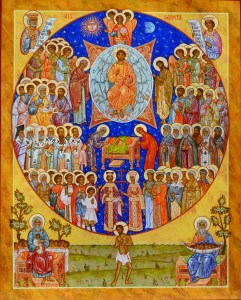
Feast of All Saints Icon

Recently, I saw a round of questions in a Facebook group which welcomes inquirers to ask questions about the Orthodox Christian faith. The questions reminded me of ones I asked more than a dozen years ago when I was at that stage of my conversion. They can be summed up like this: “How can you feel comfortable talking to the saints and the Theotokos? The prayers look like ‘worship’. My wife/husband/children are seriously confused or feel like they can’t continue in learning about Orthodoxy over this issue.”

Revisiting these doubts and concerns helped clarify for me why I am writing about the saints. I am not merely writing nice stories with pithy commentary. I want to introduce you to real, living people who want to be a part of your earthly journey. The ultimate goal of learning about the saints is to get to know them, as you would know your family and your colleagues and your teammates.

For those who were not raised in the Church and even those who may not have had strong grounding in the faith, their understandings of the ‘dead’ and the ‘living’ are not the same as the prevailing bifurcated Western mindset. Fr. Stephen Freeman describes this division as a ‘two story universe”. God lives above us, separated from our affairs on earth. When someone dies, and they seemed like a decent human, we think of them as with God, again, separated from our first floor existence. In the reverse, if someone was clearly rubbish at living on earth, they get tossed into the the ‘basement’ of hell. Meanwhile, we carry on in our sphere, with gulfs fixed between the basement and the second story. We might hear a footstep or two from above our heads and proclaim, ‘miracle!’ but that is the most we can hope for. One someone is dead – they are truly gone away. The best we can do is celebrate their lives on the first floor because that was all we were certain of. In the modern parlance, “you are dead to me”, sums up the idea: this person no longer exists in an interactive way in my life.

The Liturgy, the primary mission of the Church, is the uniting of Heaven and Earth for the healing of mankind. We Orthodox Christians live in a one story universe. There is no ‘practice my religion’ time and every other moment where God is forgotten. The Holy Spirit moves and broods and is active everywhere. Those who repose have not merely become worm food and vanish into a great unknown. We do not fairy wish that someday we might see our loved ones again after we die. When say we live in a great cloud of witnesses (Hebrews 11 and 12:1), they continue to see the world because there is no death in Christ. Those the Church recognizes as saints have their holiness rise to the surface of our memories and their continued action within the Church serves as a confirmation.

The honoring of saints and asking their intercessions is also part of the living tradition of the Church. G.K. Chesterton describes tradition as, “…giving a vote to most obscure of all classes, our ancestors. It is the democracy of the dead. Tradition refuses to submit to the small and arrogant oligarchy of those who merely happen to be walking about. All democrats object to men being disqualified by the accident of birth; tradition objects to their being disqualified by the accident of death. Democracy tells us not to neglect a good man’s opinion, even if he is our groom; tradition asks us not to neglect a good man’s opinion, even if he is our father.” (Orthodoxy, p. 48) Either the Church is universal through time and space or it is not universal at all. Beyond recounting stories, we continue to experience their aid and presence in our lives. This adds to their “lives” as lived in Christ with us.

What I hope to do through this blog is the write what I consider a ‘speaker’s biography’, which one might encounter before attending a conference. You will know enough to recognize them in public and appreciate what they have to say. Unlike most conferences, however, you then get to share dinner with them, then have unlimited access to talk with them any time afterwards. They become friends, surrogate family members, teachers, counselors, protectors, providers, finders of lost things (and people), and so many other points of relationship.

You are never alone as an Orthodox Christian. Let me repeat that: You are never alone! There is no suffering, no shame, no triumph, no need, no insurmountable task, no sadness, no joy, nothing that has not been shared by a fellow saint in their earthly struggle. Unlike our fellow Christians in the flesh, they have finished the race. They can tell you every pothole, every twist and turn, dark corners where enemies lurk to pull you away from the goal. They can protect you, as a mother protects a toddler from rushing towards danger. Even if you are holed up for years in solitary confinement or hide on a  rock in a desert, there you will find a feast prepared for you, with guests innumerable. Come, let us join them!

Saint Melangell and the Animals

Abbess Melangell

A young maiden with a hare, an old woman with a lion, a hermit with a bear, a dying woman with dove, what do all these people and animals have in common? They are signpost towards the Kingdom of God – one marked with gentleness and reconciliation. With the incarnation and resurrection of Christ, the reconciliation in and among His Creation has certain signs for us to see as a return to this original relationship. The hallmark of living out the Gospel in the world is the peace a soul reaches with Creation through asceticism and gratitude. The hagiographic theme of saints’ interactions with animals is consistent sign of holiness.

High up in the Berwyn hills of northern Wales, in the late 6th century, a young Irish woman found solitude in prayer with her God. She lived in the wilderness before being discovered in a rather dramatic and fabled way. Melangell, by the tradition, was the daughter of the King of Strathclyde, who had renounced the world and sought to convert the Welsh. Thus she lived for several years in asceticism.

Prince Brychwel Ysgithrog, from what is now Shrewsbury, was a good Christian man, giving alms to the poor in his realm. He took his dogs out hunting one day near Pennant, a remote valley. The dogs startled a hare and went off in pursuit, with the Prince following on horseback. They chased it into a thick bramble, however, the dogs came running back out in fear. The Prince dismounted and went into the hedge to see what had frightened them. There he saw a young woman, standing at prayer, with the hare hiding at the hem of her dress.

Astonished, he asked who she was and where she had come from. Learning of her birth and her mission, at first, he felt compassion for her. Some stories say he proposed marriage first, to which she declined. His second offer, however, was more to her liking. He gave the land surrounding her as dedicated to God so that a church may be built. Other virgins gathered to Melangell to dedicate themselves to prayer and hospitality to the poor. Local traditions say that hares were always found in great number surrounding the settlement and called them ‘Melangell’s lambs’. In perpetuity, after Prince Brychwel’s death, this deed was honored and a church has continuously operated as a shrine to St. Melangell to this day. Her relics and those of the nuns who came to Pennant, were also discovered recently and several miracles are attributed to her.

What might seem like a fairy tale suitable for animation in the life of St. Melangell is really a kind of deep truth being played out in the lives of saints. A wild hare which seeks sanctuary with a human is a sign of that person’s sanctity. Indeed, the very idea of ‘wild’ animals is a byproduct of sin; we broke the relationship of caretaker for all of Creation and put fear between us. This fear is a two-way street, either the animals flee us because we may cause them harm or they could attack or poison us. As St. John Chrysostom writes:

It is clear that man in the beginning had complete authority over the animals…. But that now we are afraid and terrified of beasts and do not have authority over them, this I do not deny…. In the beginning it was not so, but the beasts feared and trembled and submitted to their master. But when through disobedience he lost boldness, then also his authority was diminished. That all animals were subject to man, hear what the Scripture says: He brought the beasts and all irrational creatures to Adam to see what he would call them. (Gn. 2:19) And he, seeing the beasts near him, did not run away, but like another lord he gives names to the slaves which are subject to him, since he gave names to all animals… This is already sufficient as proof that beasts in the beginning were not frightful for man. But there is another proof not less powerful and even clearer. Which? The conversation of the serpent with the woman. If the beasts had been frightful to man, then seeing the serpent the woman would not have stopped, would not have taken his advice, would not have conversed with him with such fearlessness, but immediately on seeing him would have been terrified and run away. But behold, she converses and is not afraid; there was not yet then any fear. (Homilies on Genesis, IX, 4)

Animals, by their type and their actions, are both real actors and symbols within hagiography. What do I mean by ‘real actors’? There were physical creatures who had relationships with saints and were witnessed in behaving in ways not regularly observed for wild animals. St. Zosimas had a lion come help him dig a grave for Mary of Egypt, marking both his sanctity (though he was afraid in the moment) and that of the reposed.  Symbolically, animals can be signs or portents of the spiritual realm. For example, when St. Scholastica died, her brother, St. Benedict, saw a dove ascend from her monastic cell and he knew she had reposed.   In one of the tales surrounding the life of St. Brigid is one where a poor family came to the saint with their cow who had gone dry inexplicably. She touched the cow and it returned to giving milk, ten times the amount before. This illustrates the providence of God to the poor and the compassion of the saint.

How does this healing between humans and Creation occur? Through asceticism and gratitude. Elizabeth Theokritoff notes, in her book, Living in God’s Creation: Orthodox Perspectives on Ecology, “Asceticism provides the link between our relationship to the material world and our spiritual life. It reveals to us that the way we use material things is absolutely crucial to our spiritual progress.” Fasting, giving alms, denying the passions all have the goal of transfiguring our lives into that which reflects brightly reflects Christ to the world. We rightly place ourselves in the order of Creation through gratitude. Theokritoff continues, “At the basis of that attitude is the understanding of the created world as God’s gift. Not a ‘gift’ in the sense that it is handed over to us to do what we like with; rather, in the sense that it is never ours by right. It entails a constant connection with a Giver, a cause of endless gratitude to one who graciously gives us the enjoyment of what is His own.”

The fruit of this ascetic labor is to return to the original authority structure in Paradise, where our Divine image is restored. Though we are still within the fallen world, glimpses of what this was and will be, are truly transformative. As St. Isaac the Syrian remarks, the mechanics of this renewed relationship is the recognition of the divine, “The moment they catch sight of the humble man their ferocity is tamed; they come up and cling to him as to their Master, wagging their tails and licking his hands and geet. They smell, as coming from that person, the same fragrance that came from Adam before the transgression, the time when they were gathered together before him and he gave them names in paradise. This scent was taken away from us. But Christ has renewed it and given it back to us at his coming.” (Homily 77) As with all relationships, animals also retain a choice as to whether they will engage with us. They may cooperate or choose to cohabit with us or keep to their regular life in the wild. The humble man removes the barriers for this choice.

St. Nektary of Optina said, “St. Gerasimus was a great saint and he cared for a lion. We are little so we have cats.” We all have little ways to pursue gentleness with God’s creation. How have you seen wild animals react to patient love and humility? How can we better cultivate relationships with the small living creatures and the great?

…….

Read more about St. Melangell in this excellent article from Road to Emmaus.

More quotes from the Church Fathers regarding our relationship with Creation.

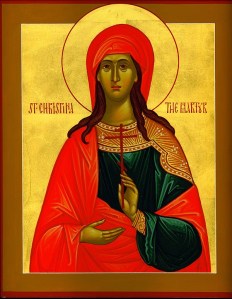
Saint Christina the Great Martyr and Owning Your Faith

Saint Christina the Great Martyr

Saint Christina was born in Tyre, an important port city along the Mediterranean, just to the west and north of Galilee in the mid-200s AD. Her father was the pagan Roman governor of that city and surrounding region. At the age of 11, Christina was a beautiful and intelligent young lady, who could garner any future marriage proposals she wished. Her parents, however, chose to dedicate Christina as a pagan priestess. In order to discern which god or goddess she would serve, her mother locked the girl into a small house with her servants and many different idols, hoping one would choose her daughter as a devotee.

During her home imprisonment, Christina began to study the stars and what natural beauty she could see from her window. Just as St. Paul remarked to the Athenians, to begin his soliloquy in the Areopagus, (Acts 17), Christina intuitively discerned there was an ‘Unknown God’ who had created the world and He was sovereign over it. The idols in her room were just the creation of men and could do nothing, she reasoned. She began to pray to this Unknown God and fasted, asking Him to reveal Himself.

In time, an angel appeared to Christina and taught her the true faith of Christ. The angel also forewarned her of the things she was to suffer. Seeing the idols as now superfluous, Christina smashed them all and threw them out the window. When her father visited, he asked where all the idols had gone. Christina was silent. When the servants told him, her father flew into a rage and slapped his daughter. She then gave the explanation of her new faith in Christ. The hapless servants were all put to death and Christina was dragged off to prison.

The pleading of her mother did not change her mind nor a trial to which Christina was given one last opportunity to recant. A long series of tortures awaited the young maiden. For Christina, her valiant struggle included burning over fire, being locked in a furnace for 5 days, and multiple beatings. An angel came and revived her at one point. Her torturer thought this was sorcery and he died immediately as a consequence. During her long imprisonment, people from the surrounding area began to visit her and she brought about the conversion of 300 souls. Finally, she was executed with a sword. Her feast day is July 24th.  

To help refresh our memories, martyrs are categorized in the menaion with certain titles:
Martyrs as a whole are those saints who suffered death in Christ’s name, for remaining loyal to the true faith, or for refusing to serve idols. They often had no warning about their immediate suffering and were sometimes ‘baptised in their blood’.

Great Martyrs are those saints who suffered particularly harsh treatment and punishments before suffering death.

Hieromartyrs are those saints who suffered death as priests.

Venerable Martyrs are those saints who suffered death as a member of monastic orders.

Source

Saint Christina is entitled a Great Martyr because she endured many rounds of suffering before her death. As modern readers, we often wonder why the stories of martyrs were so ‘gruesome’ in their details. In the wisdom of the Church, we can see that certain things, like cruelty and hatred, have endured where and whenever Christians have lived. The cast of characters have changed and their motivations, whether religious or political, have altered, but the means of breaking men & women in mind, body, and soul have not. We read the lives and deaths of martyrs not as quaint and curious stories of long ago from a vantage point of safety and prosperity. Anyone of us might be called to wear the crown of martyrdom in our lives; a sudden reckoning or a slow, torturous beat down is always a possibility for the final witness of a Christian.

We do not sugar-coat suffering or the reality and consequences of sin as Orthodox Christians. When teaching children, it is helpful to ‘titrate’ the stories where the details of sin might not be comprehensible. An example might be, when teaching the life of Mary of Egypt, to describe her pre-repentant life as one where she could not choose to do right at all. Otherwise, as children grow in their life experience and knowledge, we do them no favors by sparing details. They can handle much more than we give them credit.

From the lives of virgin martyrs, especially, we draw the lesson of ‘owning our faith’. We take responsibility of how we honor our bodies as temples of the Holy Spirit  through what we eat, what we listen to, what we look at, where we spend our time, and how we move. These are small, daily choices, often with small social consequences. They add up, though, like a tree which bends to find sunlight and can be warped for life. For martyrs, the choice is a high-stakes one – choose bodily life over spiritual death. In both cases, the consequences are the same – life or death, slowly or quickly. Christina, in her youth, chose spiritual life and a martyrs crown. Training ourselves through fasting, prayer, liturgical worship, and study means we will be prepared for the tests, both great and small, where we may have to say, “I belong to Christ!”

Read more about the life of St. Christina the Great Martyr


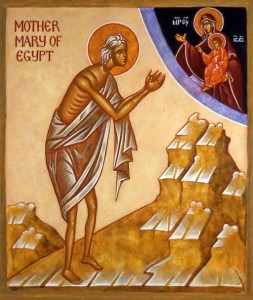
Saint Mary of Egypt and the Problem of Spiritual Pride

St. Mary of Egypt

When you think you have arrived, you have only just begun. This is the greatest life lesson for St. Zosimas and he learned it from a naked woman in the desert.

Mary was a beautiful girl, living in Alexandria. She left home at age twelve and lived a life of open sexual gratification. Rather than take pay from her partners, Mary supported herself through spinning flax or begging. Her pride in physical seduction, the thrill of the pursuit of men, kept her in this life for several years. One day, she heard a group of men were to set sail for the Holy Land in order to venerate the True Cross in Jerusalem. Thinking this would be an adventure, Mary joined them on the boat, trading her services with the men for passage.

Upon arriving in Jerusalem and following the crowds to the Church of the Holy Sepulchre, Mary was held back at the doorway by an unseen force. She tried three times to enter, but it was impossible. Mary looked up at an icon of the Theotokos, which brought her to tears and repentant prayer. She promised the Theotokos that she would renounce her passionate life and follow Christ. She fled to the desert and wrestled with ‘mad desires and the passions’ for 17 years. After that period of time, she dwelt in prayer and solitude for another 30 years, when she met Zosimas.

Saint Zosimas lived a contemporary life to Mary, in Palestine. His parents took him to a monastery at a young age, some accounts say just after he was weaned. All he knew was a monastic way of life, which he embraced and stayed, excelling at the study of Scriptures and at asceticism.

Zosimas was tormented with the thought that he had reached perfection in everything and could not learn anymore in the spiritual path to God. The voice said, “Is there a monk on earth who can be of use to me and show me a kind of asceticism that I have not accomplished? Is there a man to be found in the desert who has surpassed me?”

In a way, he was right. He knew the lives of his fellow brothers and of the lives of the desert fathers in the Sinai and beyond. Many of them made pilgrimage to visit Zosimas for his wisdom and teaching. All the indicators from his vantage point showed him there was nothing else to gain where he was, and what could be gained, like physical portliness, is pride.

Then an angel appeared with this message:
“Zosimas, valiantly you have struggled, as far as this is within the power of man, valiantly have you gone through the ascetic course. But there is no man who has attained perfection. Before you lie unknown struggles greater than those you have already accomplished. That you may know how many other ways lead to salvation, leave your native land like the renowned patriarch Abraham and go to the monastery by the River Jordan.”


In obedience to the vision, Zosimas left his home at age 53 and lived the rest of this life near the River Jordan. Here, the monks observed the Lenten fast by going out into the desert in solitude. While wandering in the desert, Elder Zosimas crossed paths with Mary, who told him her life story. The tales of both saints were recorded by Saint Sophronios, Patriarch of Jerusalem in the mid-600s.

Another father among the saints had a similar revelation to Zosimas –

“It was revealed to Father Anthony in the desert that there was one who was his equal in the city.  He was a doctor by profession and whatever he had beyond his needs he gave to the poor, and every day he sang the Trisagion with the angels.”

~From the 38 Sayings of Saint Anthony 

Both Zosimas and Abba Anthony had an experience of the parable of the rich young ruler.

Then Jesus, looking at him, loved him, and said to him, “One thing you lack: Go your way, sell whatever you have and give to the poor, and you will have treasure in heaven; and come, take up the cross, and follow Me.” [Mark 10:21]

To outward appearances, yes, the monastics had left the world in obedience to Christ’s commandment, forsaking wealth and status. What they could not forsake, except through labor and repentance, was pride. Zosimas was led to a stricter monastery; Abba Anthony saw a man living in a town who excelled him in prayer and charity. Comfort and stagnation is a different experience for everyone, as is the remedy of asceticism.

Both Zosimas and Mary suffered from what might be called, ‘a big fish in a small pond’ syndrome. Mary, in her sinful state, could acquire any pleasure she wanted. Zosimas, in his monastic home of 50 years, knew all there was about that Christian way of life, in that context. Gretchen Rubin, author of Better than Before: Mastering the Habits of our Everyday Lives, describes a tactic for when to begin a new habit called the clean slate. The clean slate is a moment in our lives where a big change occurs: marriage, changing jobs, graduating from school, etc. At these moments, when major behavior patterns shift to accommodate new people or new places, it is easier to change our personal behaviors, good or bad. A repeated pattern in many saintly lives is this clean slate type of move. Staying stagnant in sin is easy; repentance requires a new direction and, most importantly, movement.

Physical pride, of the kind Mary of Egypt owned, can be dealt with through physical asceticism and attempted profitably, sometimes, alone, which is why we have hermits or hermitesses. Mary knew she had no bargaining chips in her hands in regards to her soul: no godly heritage, no inclination throughout her youth towards God, no elder to shepherd her. For Mary, her remedy to overwhelming physical pride was renouncing all pleasures and contact therewith. Spiritual pride needs the mirror of living with others, even just seeing one other humble person in daily life is enough to bring us to repentance. There will always be someone in the Kingdom of God who is more ‘least’ than you.

Mary is a surprisingly contemporary saint for our decadent times. She made choices to suit her libertine tastes in ways that do not fit the paradigm we commonly assign to women of ancient history. As a professional, single woman living in a wealthy North American city, I could choose almost any way of life I wanted: eat whatever and whenever, associate with whomever I liked, wear whatever styles I choose, consume any media, and communicate with anyone in the world. Alexandria in late antiquity was a similar venue. Mary, being held back from entering the church, was the first time she encountered a ‘no’ to her wishes. We cannot have both worlds. Embracing the cross means we have to put down the other passion-fueled agendas in our arms, both the glory of physical pride and the illusion of spiritual success.

The story of Saints Zosimas and Saint Mary

Saint Scholastica and Breaking the Rule

St. Scholastica and St. Benedict

The Orthodox are known for our rules and for not keeping them, or so it appears to the outside world. We have a term, oikonomia, which is applied to situations where the rule would be harmful or overly harsh to a person or a parish. We scale the strictness of fasting to age or infirmity or childbearing. There are rules (which we follow most of the time) and then there is life. We choose life.  

St. Benedict and his younger sister, Scholastica, are also known for their monastic Rule, which is lived out in monasteries around the world to this day. The holy pair were born in 470 and 480 AD, respectively, in what is now northern Italy. From a young age, her parents dedicated her to God. In this transitional time in the west, where monasticism was still a forming concept, dedicating a boy or girl to God meant living as a consecrated virgin in the home or with a small group of others, informally connected to the Church. In the eastern desert, cenobitic monasticism was already going strong with the rule of St. Pachomius. St. Benedict began his ascetic struggle with such an informal group, when he did a miracle of repairing a broken wine vessel, he fled the ensuing attention to an abandoned villa, to live as a hermit.

St. Benedict was entreated to become an abbot for a group of monks. He instilled order to this unruly band, which they did not like. They tried to poison their abbot, but was not successful, since St. Benedict had prayed over the wine and the poison was neutralized. Again, he fled to his mountain retreat. This seclusion did not last long and soon, he found monks gathering near him. He took this as a sign to organize monasteries, based on his Rule, to create a stable life and witness for the Church.

Scholastica joined one of these monasteries a few miles from Monte Cassino, where she eventually became mother abbess and lived out the remainder of her days. Stability is one of the vows Benedictine monastics take, along with obedience and ‘conversion of life’ or poverty and chastity. At the time of the monastery foundations, there was a problem in the countryside of wandering monks, who often did scandalous things. Both Scholastica and Benedict took their vow of stability seriously, that they did not enter each others’ monasteries. They wrote to each other frequently but that did not satisfy their desire to see each other, as siblings engaged in the same struggle.

A compromise was found. One day per year, the brother and sister would meet at a house between the two monasteries to discuss their joys and sorrows. They continued in this routine for many years, until the very last. In 543, St. Scholastica knew her death was imminent. She begged her brother to stay overnight so they could have more time to talk. He refused to be away from his cell for even one night, which would break his rule, and made to leave. Scholastica prayed for God to intervene. A severe storm erupted and continued so that Benedict and his brothers could not leave. He said, “May Almighty God forgive you sister for what you have done!”

She replied, “I asked a favor of you and you refused it. I asked it of God, and He has granted it!”

Thus reproved for his strictness, Benedict stayed and consoled his sister.

Three days later, St. Benedict had a vision of his sister’s soul ascending to heaven like a dove. He had her buried in his own tomb and later joined her in repose. Her feast day is February 10th. She is portrayed in iconography with a dove and a crosier.

This beautiful story, recorded by St. Gregory the Great, shows us how, at times, even the most faithful must learn to break a rule, even one which bears their name, for the sake of life and love. Strictness brings order and training on the path of salvation. Gentleness brings healing.

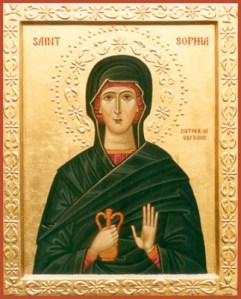
Saint Sophia of Thrace and What to Do Next

St. Sophia of Thrace

What do you do when your plans go to ruin through unexpected ways? The lives of many saints show us the choices they made when confronted with the unthinkable: deaths of loved ones, natural disaster, persecution, abandonment, disease or infirmity, financial calamity, wars, famine, and so on. For the holy women we remember who faced such disaster, what they chose to do next is the illustration of their character and their faithfulness to God.

A recurring theme in good hagiography is one of holy eucatastrophe. This term, coined by J.R.R. Tolkein, is commonly defined as the happy resolution, an impossible problem which is solved by the end of a story. Why do I predicate eucatastrophe with the word holy? In the lives of saints, the plot twist in their lives is not usually rectified to the same status they were before. They may not have another child or remarry or regain wealth or live in peaceful times, all tropes we like to read or see in fairy tales. The resolution, the good to come from disaster, is a transformation of this person’s life path for their salvation, the choice to do good.

St. Sophia is known to us as ‘The Mother of Orphans’. In the first half of her life, however, she was a mother and wife, a devoted Christian woman, living in Thrace, most likely before 700 AD. She had borne 6 children and in the midst of a busy family, did not neglect prayer or Church attendance. A plague swept through her town, carrying off her husband and each of her children in quick succession. Sophia was now a childless widow.

There is a quote from Dorothy Day which I keep written at the beginning of my journals, where she offered advice to a young man who needed discernment about his life’s path.


“Pray this prayer, ‘Lord, what would you have me to do?’ The answer to this prayer is finding yourself doing more than you ever thought possible.”

In my experience, the work God has for us, especially when we are faced with monumental changes, is so much more than we can dream. I underestimate myself constantly and hide in fear of failure or of conflict. The parable of hiding talents is my constant reminder to use what little I have been given. I feel special kinship with these types of saints because they allowed the Holy Spirit to work humility in their lives, while at the same time, doing great works of faith.

Sophia, whether she consciously prayed this prayer or not, went about doing much more than she had expected in the second half of life. For the next twenty years, she took in 100 orphans and raised them as Christians. She sold property to care for fellow widows. She preferred to do without the necessities of life herself rather than allow any poor person to leave her home empty-handed. She continued to be a mother, seeing the fruit of her love grow in a multitude of ways beyond her first loss.

God blessed her humility and generosity through a unique miracle. She had a jug of wine that she used to serve poor guests. The jug never emptied and was replenished every day. This continued until Sophia told another person of the miracle and the wine dried up. She was immediately sorrowful about her indiscretion. Sophia took the monastic tonsure before her repose at age 53. Her icon often depicts her holding the wine jug as a sign of God’s provision. Her feast day is June 4th.

More about St. Sophia:

Venerable Sophia of Ainos

St. Sophia of Thrace