Queen Tamar of Georgia and Leadership

Queen Tamar of Georgia

Our culture exalts the potential of every person: the self-made man, the rags-to-riches stories, the underdog heroes are our foundational mythology. While those stories are based on some true-to-life examples, what we blinded to in our glittering wealth is our creatureliness. God formed us and placed us in families, in tribes, and in countries. He gave us innate skills in our minds and bodies, so individually and precisely, to love and serve our neighbors. Our strengths bear the weaknesses of others and, in humility, we allow others to care for us as unto Christ.

Do we not have choices? Of course we do! Queen Tamar knew what she would become from the earliest age – but how she would be known to her people was up to her. The Parable of Talents illustrates just how the balance of human free will and divine providence works in the Kingdom of God. (Matthew 25)  Throughout the ages, Orthodox Christians with great wealth knew they were handed a five or two talent deal when they were born. Some could make the choice of giving away the physical treasure to gain spiritual life, such as St. Marcella or Abba Anthony. Others, like royalty, knew their lot was cast with their people.

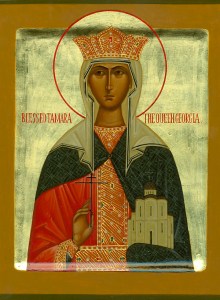
When Queen Tamar took the throne at age 17 after her father’s death, she convened a Georgian church council to address the clergy. She said, “Judge according to righteousness, affirming good and condemning evil. Begin with meif I sin I should be censured, for the royal crown is sent down from above as a sign of divine service. Allow neither the wealth of the nobles nor the poverty of the masses to hinder your work. You by word and I by deed, you by preaching and I by the law, you by upbringing and I by education will care for those souls whom God has entrusted to us, and together we will abide by the law of God, in order to escape eternal condemnation…. You as priests and I as ruler, you as stewards of good and I as the watchman of that good.”

Her speech is an excellent summation of what leadership for an Orthodox Christian looks like. What comes with the package deal, whether you lead a scout troop or a nation, you are a man or woman, young or old? There are three primary duties incumbent on leaders which Queen Tamar exemplified: service, generosity, and intercession. We heard of her valiant military command and shrewd political dealings with the Turks, which are rightly heroic, however, with any leader, what happens in the heat of life’s battle is the result of years of training towards unflinching, habitual response. Wisdom is knowledge wearing worn, muddy boots.

King George III knew that for his daughter to succeed as a full monarch of their people, she needed intense and lengthy training, which is why he made her co-regent at age twelve. For five years, she saw the daily choices her father made, learned who were the powerful people in the land and what their motivations were, which enemies could be trusted or not, and how to set the tone of piety for the court. She learned her role as a servant for the people. Though the power was hers to decide the fate of men, she knew the decisions were for everyone’s benefit or detriment, not for her personal schemes. For example, her first husband was the pick of the court and the Church. While George Rusi was a brave soldier, he lived a flagrantly immoral life, which brought shame to Queen Tamar. The court sent him away and the Church granted a divorce. George Rusi tried twice to overthrow the Queen’s rule but he was foiled each time. She would have been quite happy to remain unmarried but the pressure resumed for her to continued the royal line. Tamar asked her aunt, her king father’s sister, to choose her next spouse. Prince Davit-Soslan Bagrationi became a trusted co-ruler and military commander for Tamar, and father to her son and daughter. (While we use the term ‘queen’ for Tamar, in Georgian, the term is mep’e, which is best translated as ‘sovereign’, not a gender specific title. She would remain styled as mep’et’a mep’e, or ‘king of kings’ after her marriage.)

Service in leadership is also personal. Queen Tamar would wear her golden array to govern her people during the day and at night she would pray and sew. One evening, in exhaustion, she fell asleep and had a vision of richly decorated throne. She approached it, assuming it was hers, but an angel stopped her. “Who is more worthy than I to receive such a glorious throne?” The angel replied, “This throne is intended for your maidservant, who sewed vestments for twelve priests with her own hands. You are already the possessor of great treasure in this world.” And he took her away. When she awoke, the Queen set about to sew the twelve vestments as repentance for assuming an honor was hers.

The Queen learned that vanity and pride are always at the door, like hungry beasts, to eat away at humility. She was preparing to attend a festal liturgy and was fastening precious rubies to her belt. A beggar came to the monastery door and was told to wait for the Queen’s entourage. When the Queen was finely dressed, she found the beggar had gone away. She became greatly saddened at her vanity which prevented her from denying Christ in the disguise of a beggar and offered the ruby belt to the Gelati Icon of the Theotokos.

Throughout her life, Queen Tamar undertook ascetical labors in secret. During military battles, she would pray continuously until she received word of the outcomes, leading her troops to the city gates barefoot. Through prayer, the Queen recognized she is one under authority and one entrusted with authority, like the Centurion. When Queen Tamar was nearing the end of her earthly life, she is recorded as saying her final prayer, “Lord Jesus Christ! Omnipotent Master of heaven and earth! To Thee I deliver the nation and people that were entrusted to my care and purchased by Thy Precious Blood, the children whom Thou didst bestow upon me, and to The I surrender my soul, O Lord!”

Queen Tamar is an extraordinary example of a woman in leadership – for her own time and for all of Christian history. With studying the saints, it is easy to think they are outliers to regular human experience, and think what they accomplish in their lifetimes is not possible for the rest of us. True, I was not born into a royal family and a kingdom was dependent upon my wise choices. My responsibilities are miniscule in that regard. Yet, the gifts I have now, of communication, easy travel, potential influence, monetary wealth and physical comfort, all of these are astronomically above what Queen Tamar could comprehend. The model our ‘king of kings’ upholds for us is to wear our golden robes lightly, with humility, knowing in our final breath we surrender our multiplied talents back to God.
Read more about the life of Queen Tamar of Georgia.

Saint Christina the Great Martyr and Owning Your Faith

Saint Christina the Great Martyr

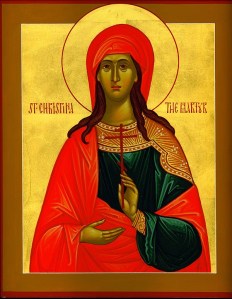
Saint Christina was born in Tyre, an important port city along the Mediterranean, just to the west and north of Galilee in the mid-200s AD. Her father was the pagan Roman governor of that city and surrounding region. At the age of 11, Christina was a beautiful and intelligent young lady, who could garner any future marriage proposals she wished. Her parents, however, chose to dedicate Christina as a pagan priestess. In order to discern which god or goddess she would serve, her mother locked the girl into a small house with her servants and many different idols, hoping one would choose her daughter as a devotee.

During her home imprisonment, Christina began to study the stars and what natural beauty she could see from her window. Just as St. Paul remarked to the Athenians, to begin his soliloquy in the Areopagus, (Acts 17), Christina intuitively discerned there was an ‘Unknown God’ who had created the world and He was sovereign over it. The idols in her room were just the creation of men and could do nothing, she reasoned. She began to pray to this Unknown God and fasted, asking Him to reveal Himself.

In time, an angel appeared to Christina and taught her the true faith of Christ. The angel also forewarned her of the things she was to suffer. Seeing the idols as now superfluous, Christina smashed them all and threw them out the window. When her father visited, he asked where all the idols had gone. Christina was silent. When the servants told him, her father flew into a rage and slapped his daughter. She then gave the explanation of her new faith in Christ. The hapless servants were all put to death and Christina was dragged off to prison.

The pleading of her mother did not change her mind nor a trial to which Christina was given one last opportunity to recant. A long series of tortures awaited the young maiden. For Christina, her valiant struggle included burning over fire, being locked in a furnace for 5 days, and multiple beatings. An angel came and revived her at one point. Her torturer thought this was sorcery and he died immediately as a consequence. During her long imprisonment, people from the surrounding area began to visit her and she brought about the conversion of 300 souls. Finally, she was executed with a sword. Her feast day is July 24th.  

To help refresh our memories, martyrs are categorized in the menaion with certain titles:
Martyrs as a whole are those saints who suffered death in Christ’s name, for remaining loyal to the true faith, or for refusing to serve idols. They often had no warning about their immediate suffering and were sometimes ‘baptised in their blood’.

Great Martyrs are those saints who suffered particularly harsh treatment and punishments before suffering death.

Hieromartyrs are those saints who suffered death as priests.

Venerable Martyrs are those saints who suffered death as a member of monastic orders.

Source

Saint Christina is entitled a Great Martyr because she endured many rounds of suffering before her death. As modern readers, we often wonder why the stories of martyrs were so ‘gruesome’ in their details. In the wisdom of the Church, we can see that certain things, like cruelty and hatred, have endured where and whenever Christians have lived. The cast of characters have changed and their motivations, whether religious or political, have altered, but the means of breaking men & women in mind, body, and soul have not. We read the lives and deaths of martyrs not as quaint and curious stories of long ago from a vantage point of safety and prosperity. Anyone of us might be called to wear the crown of martyrdom in our lives; a sudden reckoning or a slow, torturous beat down is always a possibility for the final witness of a Christian.

We do not sugar-coat suffering or the reality and consequences of sin as Orthodox Christians. When teaching children, it is helpful to ‘titrate’ the stories where the details of sin might not be comprehensible. An example might be, when teaching the life of Mary of Egypt, to describe her pre-repentant life as one where she could not choose to do right at all. Otherwise, as children grow in their life experience and knowledge, we do them no favors by sparing details. They can handle much more than we give them credit.

From the lives of virgin martyrs, especially, we draw the lesson of ‘owning our faith’. We take responsibility of how we honor our bodies as temples of the Holy Spirit  through what we eat, what we listen to, what we look at, where we spend our time, and how we move. These are small, daily choices, often with small social consequences. They add up, though, like a tree which bends to find sunlight and can be warped for life. For martyrs, the choice is a high-stakes one – choose bodily life over spiritual death. In both cases, the consequences are the same – life or death, slowly or quickly. Christina, in her youth, chose spiritual life and a martyrs crown. Training ourselves through fasting, prayer, liturgical worship, and study means we will be prepared for the tests, both great and small, where we may have to say, “I belong to Christ!”

Read more about the life of St. Christina the Great Martyr


Saint Mary of Egypt and the Problem of Spiritual Pride

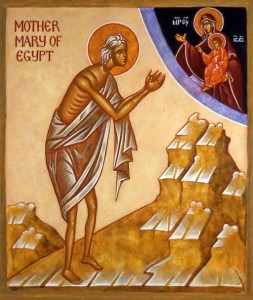
St. Mary of Egypt

When you think you have arrived, you have only just begun. This is the greatest life lesson for St. Zosimas and he learned it from a naked woman in the desert.

Mary was a beautiful girl, living in Alexandria. She left home at age twelve and lived a life of open sexual gratification. Rather than take pay from her partners, Mary supported herself through spinning flax or begging. Her pride in physical seduction, the thrill of the pursuit of men, kept her in this life for several years. One day, she heard a group of men were to set sail for the Holy Land in order to venerate the True Cross in Jerusalem. Thinking this would be an adventure, Mary joined them on the boat, trading her services with the men for passage.

Upon arriving in Jerusalem and following the crowds to the Church of the Holy Sepulchre, Mary was held back at the doorway by an unseen force. She tried three times to enter, but it was impossible. Mary looked up at an icon of the Theotokos, which brought her to tears and repentant prayer. She promised the Theotokos that she would renounce her passionate life and follow Christ. She fled to the desert and wrestled with ‘mad desires and the passions’ for 17 years. After that period of time, she dwelt in prayer and solitude for another 30 years, when she met Zosimas.

Saint Zosimas lived a contemporary life to Mary, in Palestine. His parents took him to a monastery at a young age, some accounts say just after he was weaned. All he knew was a monastic way of life, which he embraced and stayed, excelling at the study of Scriptures and at asceticism.

Zosimas was tormented with the thought that he had reached perfection in everything and could not learn anymore in the spiritual path to God. The voice said, “Is there a monk on earth who can be of use to me and show me a kind of asceticism that I have not accomplished? Is there a man to be found in the desert who has surpassed me?”

In a way, he was right. He knew the lives of his fellow brothers and of the lives of the desert fathers in the Sinai and beyond. Many of them made pilgrimage to visit Zosimas for his wisdom and teaching. All the indicators from his vantage point showed him there was nothing else to gain where he was, and what could be gained, like physical portliness, is pride.

Then an angel appeared with this message:
“Zosimas, valiantly you have struggled, as far as this is within the power of man, valiantly have you gone through the ascetic course. But there is no man who has attained perfection. Before you lie unknown struggles greater than those you have already accomplished. That you may know how many other ways lead to salvation, leave your native land like the renowned patriarch Abraham and go to the monastery by the River Jordan.”


In obedience to the vision, Zosimas left his home at age 53 and lived the rest of this life near the River Jordan. Here, the monks observed the Lenten fast by going out into the desert in solitude. While wandering in the desert, Elder Zosimas crossed paths with Mary, who told him her life story. The tales of both saints were recorded by Saint Sophronios, Patriarch of Jerusalem in the mid-600s.

Another father among the saints had a similar revelation to Zosimas –

“It was revealed to Father Anthony in the desert that there was one who was his equal in the city.  He was a doctor by profession and whatever he had beyond his needs he gave to the poor, and every day he sang the Trisagion with the angels.”

~From the 38 Sayings of Saint Anthony 

Both Zosimas and Abba Anthony had an experience of the parable of the rich young ruler.

Then Jesus, looking at him, loved him, and said to him, “One thing you lack: Go your way, sell whatever you have and give to the poor, and you will have treasure in heaven; and come, take up the cross, and follow Me.” [Mark 10:21]

To outward appearances, yes, the monastics had left the world in obedience to Christ’s commandment, forsaking wealth and status. What they could not forsake, except through labor and repentance, was pride. Zosimas was led to a stricter monastery; Abba Anthony saw a man living in a town who excelled him in prayer and charity. Comfort and stagnation is a different experience for everyone, as is the remedy of asceticism.

Both Zosimas and Mary suffered from what might be called, ‘a big fish in a small pond’ syndrome. Mary, in her sinful state, could acquire any pleasure she wanted. Zosimas, in his monastic home of 50 years, knew all there was about that Christian way of life, in that context. Gretchen Rubin, author of Better than Before: Mastering the Habits of our Everyday Lives, describes a tactic for when to begin a new habit called the clean slate. The clean slate is a moment in our lives where a big change occurs: marriage, changing jobs, graduating from school, etc. At these moments, when major behavior patterns shift to accommodate new people or new places, it is easier to change our personal behaviors, good or bad. A repeated pattern in many saintly lives is this clean slate type of move. Staying stagnant in sin is easy; repentance requires a new direction and, most importantly, movement.

Physical pride, of the kind Mary of Egypt owned, can be dealt with through physical asceticism and attempted profitably, sometimes, alone, which is why we have hermits or hermitesses. Mary knew she had no bargaining chips in her hands in regards to her soul: no godly heritage, no inclination throughout her youth towards God, no elder to shepherd her. For Mary, her remedy to overwhelming physical pride was renouncing all pleasures and contact therewith. Spiritual pride needs the mirror of living with others, even just seeing one other humble person in daily life is enough to bring us to repentance. There will always be someone in the Kingdom of God who is more ‘least’ than you.

Mary is a surprisingly contemporary saint for our decadent times. She made choices to suit her libertine tastes in ways that do not fit the paradigm we commonly assign to women of ancient history. As a professional, single woman living in a wealthy North American city, I could choose almost any way of life I wanted: eat whatever and whenever, associate with whomever I liked, wear whatever styles I choose, consume any media, and communicate with anyone in the world. Alexandria in late antiquity was a similar venue. Mary, being held back from entering the church, was the first time she encountered a ‘no’ to her wishes. We cannot have both worlds. Embracing the cross means we have to put down the other passion-fueled agendas in our arms, both the glory of physical pride and the illusion of spiritual success.

The story of Saints Zosimas and Saint Mary

A Beginning Declaration of Purpose

A few years before I first saw a Divine Liturgy or even began learning intensively about Orthodoxy, I had the intuition that my worth in Christ was more than I was being sold. It was a Friday night, and as was often my habit, I was spending it in a bookstore. I circled the Christianity section, seeing if there were any interesting new titles to peruse. A pattern in the book covers grabbed my attention as I stood in front of a section of two shelving units side by side. On the right, all the covers were in the shades of pinks, purples, and pastels. On the left, all the covers were dark browns, blues, black, and greys. You can easily guess what the major subject headings were for each shelf. Men on the left, Women on the right.

In that moment, I thought, “Am I really that different before God? Is my soul composed of cotton candy while a man’s is made of gunmetal? Are my spiritual goals consigned to a fashion doll plastic house of pop psychology with butterflies and stylized crosses attached?”

This was a hunger pang – converts can recognize those moments when you were not satisfied with what you were being fed. There had to be more and better food than what I was being served. What I knew of the Gospel message was comparable to visiting Grandma’s house. There would be a wide spread of food for Sunday dinner, and even though I did not care for the mashed potatoes, I would leave satisfied.

I came to label this cultural approach as Gender Color Coded Spirituality: sectioning men and women based on norms and placating them with specialized messages to minister to their ‘felt needs’, outside of real ones. I was tired of being told that women needed certain treatment and men another and different expectations as to how we lived. The experience is like women only being allowed to eat at a salad bar and drink kale smoothies, while men are served steak & potatoes with a pint of porter.

Do men need the companionship of other men? Yes! Do women have issues that should be addressed through the care of other women? Yes! I do not deny the strength we have together as men or women, lay or monastic. What I fear is the narrowing of concepts regarding how holiness is lived, how that looks in my culture, compared to the breadth and depth of the Church.

Gender Color Coded Spirituality is a mentality that does not translate into Eastern Christianity and it ties into several other mindsets which I see creating an unhealthy angst in women as we struggle in our salvation. Over the course of my writings here, I want to address these imbalances, both to the right and to the left. In many of my opinions, I have developed a middle of the road approach. I hope that women (and men) will be encouraged from what I write to go out and live the Gospel wherever they are.

When reading the lives of the saints, I am in awe of how women have behaved with courage, in every time and place the Church has occupied. History is specific and surprising. Grand theories only work to give a bare bones structure for understanding the past. If you stop there, you miss the vitality of lives who are remembered for being at once ordinary and extraordinary. The saints defy our generalizations at every turn. Over the last 2,000 years, women saints were educated or illiterate, wealthy or poor, married and served their families or single through choice, mobile or never left their village or monastery, held political power or shunned it, evangelized their nations or held witness to Christ through their blood.

A couple years after the bookstore epiphany, I found myself kneeling in St. Benedict Orthodox Church , a Western Rite parish, in front of an icon of St. Scholastica, waiting for a blessing along the communion line. There were questions in the back of mind that others had posed, as they learned of my new interest in Orthodoxy, “Aren’t you concerned with how they treat women?” Their underlying concern was that I would somehow be ‘subjugated’ or made to be of less worth than men by joining a religion defined through a male hierarchical leadership. As I gazed at St. Scholastica’s steady and kind face, she communicated the answer I needed:

Holiness is the equalizer between men and women.

The unbelieving reader may perhaps laugh at me for dwelling so long on the praises of mere women; yet if he will but remember how holy women followed our Lord and Saviour and ministered to Him of their substance, and how the three Marys stood before the cross and especially how Mary Magdalen — called the tower from the earnestness and glow of her faith— was privileged to see the rising Christ first of all before the very apostles, he will convict himself of pride sooner than me of folly. For we judge of people’s virtue not by their sex but by their character, and hold those to be worthy of the highest glory who have renounced both rank and wealth.
St. Jerome, Letter 127, to Principia.

Our struggle towards salvation is of equal worth in Christ’s Church. Our martyrdoms are honored the same way. Our service to the needy is as unto Christ. Our memories are held with esteem and icons are written. We all live with differing responsibilities and in different contexts. What counts is how we choose to obey God with what we are given. This is why hagiography has captured my attention: the medium of storytelling within the Church is neutral and holistic insofar as it shares to acts of heroic faith. It universally encourages all the faithful.

I will continue my thoughts and share my experiences of what it looks like to live out holiness in parish life. Be encouraged, women, there is a place for you in the Church!

Saint Scholastica and Breaking the Rule

St. Scholastica and St. Benedict

The Orthodox are known for our rules and for not keeping them, or so it appears to the outside world. We have a term, oikonomia, which is applied to situations where the rule would be harmful or overly harsh to a person or a parish. We scale the strictness of fasting to age or infirmity or childbearing. There are rules (which we follow most of the time) and then there is life. We choose life.  

St. Benedict and his younger sister, Scholastica, are also known for their monastic Rule, which is lived out in monasteries around the world to this day. The holy pair were born in 470 and 480 AD, respectively, in what is now northern Italy. From a young age, her parents dedicated her to God. In this transitional time in the west, where monasticism was still a forming concept, dedicating a boy or girl to God meant living as a consecrated virgin in the home or with a small group of others, informally connected to the Church. In the eastern desert, cenobitic monasticism was already going strong with the rule of St. Pachomius. St. Benedict began his ascetic struggle with such an informal group, when he did a miracle of repairing a broken wine vessel, he fled the ensuing attention to an abandoned villa, to live as a hermit.

St. Benedict was entreated to become an abbot for a group of monks. He instilled order to this unruly band, which they did not like. They tried to poison their abbot, but was not successful, since St. Benedict had prayed over the wine and the poison was neutralized. Again, he fled to his mountain retreat. This seclusion did not last long and soon, he found monks gathering near him. He took this as a sign to organize monasteries, based on his Rule, to create a stable life and witness for the Church.

Scholastica joined one of these monasteries a few miles from Monte Cassino, where she eventually became mother abbess and lived out the remainder of her days. Stability is one of the vows Benedictine monastics take, along with obedience and ‘conversion of life’ or poverty and chastity. At the time of the monastery foundations, there was a problem in the countryside of wandering monks, who often did scandalous things. Both Scholastica and Benedict took their vow of stability seriously, that they did not enter each others’ monasteries. They wrote to each other frequently but that did not satisfy their desire to see each other, as siblings engaged in the same struggle.

A compromise was found. One day per year, the brother and sister would meet at a house between the two monasteries to discuss their joys and sorrows. They continued in this routine for many years, until the very last. In 543, St. Scholastica knew her death was imminent. She begged her brother to stay overnight so they could have more time to talk. He refused to be away from his cell for even one night, which would break his rule, and made to leave. Scholastica prayed for God to intervene. A severe storm erupted and continued so that Benedict and his brothers could not leave. He said, “May Almighty God forgive you sister for what you have done!”

She replied, “I asked a favor of you and you refused it. I asked it of God, and He has granted it!”

Thus reproved for his strictness, Benedict stayed and consoled his sister.

Three days later, St. Benedict had a vision of his sister’s soul ascending to heaven like a dove. He had her buried in his own tomb and later joined her in repose. Her feast day is February 10th. She is portrayed in iconography with a dove and a crosier.

This beautiful story, recorded by St. Gregory the Great, shows us how, at times, even the most faithful must learn to break a rule, even one which bears their name, for the sake of life and love. Strictness brings order and training on the path of salvation. Gentleness brings healing.

Saint Sophia of Thrace and What to Do Next

St. Sophia of Thrace

What do you do when your plans go to ruin through unexpected ways? The lives of many saints show us the choices they made when confronted with the unthinkable: deaths of loved ones, natural disaster, persecution, abandonment, disease or infirmity, financial calamity, wars, famine, and so on. For the holy women we remember who faced such disaster, what they chose to do next is the illustration of their character and their faithfulness to God.

A recurring theme in good hagiography is one of holy eucatastrophe. This term, coined by J.R.R. Tolkein, is commonly defined as the happy resolution, an impossible problem which is solved by the end of a story. Why do I predicate eucatastrophe with the word holy? In the lives of saints, the plot twist in their lives is not usually rectified to the same status they were before. They may not have another child or remarry or regain wealth or live in peaceful times, all tropes we like to read or see in fairy tales. The resolution, the good to come from disaster, is a transformation of this person’s life path for their salvation, the choice to do good.

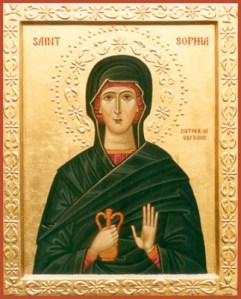
St. Sophia is known to us as ‘The Mother of Orphans’. In the first half of her life, however, she was a mother and wife, a devoted Christian woman, living in Thrace, most likely before 700 AD. She had borne 6 children and in the midst of a busy family, did not neglect prayer or Church attendance. A plague swept through her town, carrying off her husband and each of her children in quick succession. Sophia was now a childless widow.

There is a quote from Dorothy Day which I keep written at the beginning of my journals, where she offered advice to a young man who needed discernment about his life’s path.


“Pray this prayer, ‘Lord, what would you have me to do?’ The answer to this prayer is finding yourself doing more than you ever thought possible.”

In my experience, the work God has for us, especially when we are faced with monumental changes, is so much more than we can dream. I underestimate myself constantly and hide in fear of failure or of conflict. The parable of hiding talents is my constant reminder to use what little I have been given. I feel special kinship with these types of saints because they allowed the Holy Spirit to work humility in their lives, while at the same time, doing great works of faith.

Sophia, whether she consciously prayed this prayer or not, went about doing much more than she had expected in the second half of life. For the next twenty years, she took in 100 orphans and raised them as Christians. She sold property to care for fellow widows. She preferred to do without the necessities of life herself rather than allow any poor person to leave her home empty-handed. She continued to be a mother, seeing the fruit of her love grow in a multitude of ways beyond her first loss.

God blessed her humility and generosity through a unique miracle. She had a jug of wine that she used to serve poor guests. The jug never emptied and was replenished every day. This continued until Sophia told another person of the miracle and the wine dried up. She was immediately sorrowful about her indiscretion. Sophia took the monastic tonsure before her repose at age 53. Her icon often depicts her holding the wine jug as a sign of God’s provision. Her feast day is June 4th.

More about St. Sophia:

Venerable Sophia of Ainos

St. Sophia of Thrace

What is Hagiography?

St. Luke the Evangelist

What makes a good story? Is it a compelling plot? Or do you need an emotional tie to a main character? Are you disappointed with unexpected endings? Are you a fact-checker with sci-fi or historical novels and give up if the author gets the details wrong? We all approach stories with assumptions about what makes them good or dissatisfying. Hagiography, or the recording of the lives of Orthodox saints, has these unspoken assumptions, or in modern terminology, ‘tropes’ for a specific goal. Over the course of several posts, I will explore what hagiography teaches us and the fruits we can gather from the lives of every kind of saint.

I am a trained archivist; my work was to take a jumble of papers from a person or event and impart physical order so as to make a coherent system for finding information. When working with personal papers, there were several ways to go about this, but the overarching picture was to keep in mind the whole of this person’s life trajectory. As I began creating lessons centered around the lives of women saints, I delved into dozens, if not hundreds of stories, sorting out representatives to help my students understand a particular theme. I naturally picked up on patterns in the language used to describe our Orthodox saints.

Were these patterns made by unspoken little ‘t’ tradition or were there rules? Like within the tradition of iconography, are there understood symbols and depictions transmuted in language? I quickly learned there has been no academic or lengthy analysis on what hagiography is or rubrics delineating how we remember the saints. This is surprising considering how much of our liturgical life is guided through well-honed patterns.

To start with a basic definition, hagiography is writing about holiness. The goal of writing about a saint is to record what is profitable from their life story for our salvation -or- how their lives are joined with God in the world. This act of recording takes a great deal of wisdom and is much more complex than a social historian like myself would encounter when writing a biographical essay in my discipline. My emerging thesis is that hagiography is mythos meets ethos using logos or a recurrent structured story that builds towards a defining shared character for a group of people which shows the Divine life in the world.

In the next post of this series, I will explain what hagiography is not (if in doubt, go apophatic) and what are the hallmarks of good hagiography. This will be a fun rabbit trail, I promise!

Saint Genevieve of Paris and Loving Your Place

Who feels like home to you? When you go into the hardware store in your hometown, is George always at the counter? Is it memories of your grandmother on the porch with a bowl of peas to shell? Is it the announcer at the ballpark, who made each game memorable? Is it the yia-yia who stands in the same corner every week in church, praying with gentle determination for the new generation darting behind her skirts?

St. Genevieve of Paris

For any devout Parisian, St. Genevieve is their grandmother, guarding over their city like a broody hen. Throughout time and in nearly every place Orthodox Christianity has put down roots, there are saints who join themselves with a place as firmly as the bedrock. Some are in the world, either in aristocracy or as ordinary folk, and some take the monastic tonsure, as St. Genevieve. They know in their hearts, that come what may, their service to God is to love and serve Him and His people in this place, in life and in their repose.

St. Genevieve is a foundational saint in the Church of northern France, being less than two generations removed from the first bishop and martyr of Paris, St. Denis (Dionysius). Her venerable life spanned the most tumultuous years of the post-Roman era, from 419 – 512. Born to Christian parents, she was dedicated at a young age to Christ through the blessing of Bishop St. Germain, who laid his hand on her head when she was eight and asked if she wished to consecrate herself to which she gave her assent. Her mother, however, upon learning of this, became very angry and struck Genevieve and went immediately blind. Only when Genevieve forgave her mother and prayed, did the woman regain her sight.

When she was fifteen, Genevieve and several other young women presented themselves to the Bishop of Paris to receive their tonsure. The Bishop, instead of tonsuring the most senior of the women, began with Genevieve.The women dwelt with Genevieve at her grandmother’s spacious house in Paris, thus beginning the monastic tradition in the city. She was known to only eat twice a week and to pray during the night. She continued these ascetic labors until old age and infirmity decreased her austerity. Word spread of her miracles and asceticism so that even St. Symeon the Stylite heard of her exploits.

St. Genevieve worked relentlessly and bravely for the well-being and safety of her people. In 451, Attila the Hun threatened invasion of Paris. St. Genevieve and St. Germain’s deacon persuaded the Parisians to not flee the city but to pray. It was claimed that she took a torch and her sisters to the city walls as a witness and the would-be invaders turned away soon after. Again, in 464, Childeric besieged and blockaded the city. St. Genevieve passed through enemy lines untouched and brought in grain for the people. She repeatedly reasoned with both Childeric and with Clovis for peace, with the latter eventually building an abbey for Genevieve and her sisters.

Another way St. Genevieve showed devotion to the Church in France was through building the first chapel dedicated to St. Denis and honoring other Gaulic saints. The Bishop objected to the idea since there was no more limestone left in the nearest quarry. Genevieve told the Bishop that this was not so and the chapel should be built. A few days later, the deacons overheard shepherds at the bridge saying they had found another source of limestone. Genevieve and her sisters also made pilgrimages to Tours to venerate the relics of St. Martin the Wonderworker.

Her earthly pilgrimage ended in her repose in 512, at around age 93. This is not the end of her ministry to the Church in Paris. Her relics were kept in the Basilica of St. Denis until the French revolutionaries burned and dumped them into the Seine in 1793. Afterwards, other remains were gathered together from various churches and interred at Saint Etienne du Mont. Her feast day is January 3rd.

The following is a story related from Metropolitan Anthony Bloom, regarding how St. Genevieve welcomed Russian emigres to Paris and asked for their intercession and veneration:

In one of our poorest and smallest communities in Paris a woman saw a dream that she was somewhere in the thickets near a wood, that she was impelled to look at what there was within it; she found a gate, walked further and was confronted with the statue of a woman, who was holding in her hands a book and a sheaf of wheat, and this woman looked at her in sorrow and said: How is it that the people of my city, who share my faith pay me no honour. The woman awoke, there was no name she could attach to the vision; she spoke of it, but she had no answer, until a few weeks later, going to a small place not far from Paris, called Sainte Genevieve des Bois, she recognised the place of her dream, the thicket; she entered it, found a gate and was confronted with the same statue, but this time an inscription revealed to her it was Saint Genevieve, the patron saint of Paris together with Saint Denis. And she brought the news, and in our small community we began to pray to her, later we created a parish in her name, and this was the beginning of French Orthodoxy.

This opened, our minds, and our hearts to something which we had overlooked, because having lost our Country and all we loved we had a tendency to be (ingrained) in our Russian life, remembering only our Russian ancestry, both spiritual and material, the country we loved, the people who were our kin, and the saints who were the glory of Russia. And now we suddenly became aware that we had come into the West, not in a part of the world that was strange and alien to us but in a part of the world which for nearly a thousand years had shared with us the same faith, the same plenitude of oneness, the same joy of belonging together with all the Christian world. We began then to pay attention to the saints of the West and. in all countries now this awareness has grown and when we come to a country of the Western world., we know that beyond a thousand years of separation we meet the memory, the prayers, the names and the presence of those Saints of Orthodoxy who are and were its glory, its resplendence before God, we come to our own people; and this is something which is so wonderful and for which we are so deeply grateful. We are no strangers in this land, thousands and thousands of men and women have shared our faith; we are strangers in no land because the oneness of the Church hundreds of years ago unbroken make us the kin of those who are their resplendence and their glory.

Reflection:

Many of my readers are first generation Orthodox Christians, either in their place or in their families or both. Some of us have been in the founding stages of mission parishes and seen them grow into consecrated churches. I fit into both categories. My onus is, “My faithfulness contributes to this foundation and will it be strong enough for future generations to build upon?” This is a difficult thing to ponder as ‘missionaries’, when what we see now are temporary buildings, small bank accounts, and every precious convert to shepherd.

Those who live in places where Orthodoxy has deep roots, even to the beginning of the Church, your question may be framed, “Will the faith endure after me, with what I do now?” Even the mightiest oak can fall in the next storm. 

We all have the same responsibility of Christians at any time and any place – the faith endures because of us! Perhaps we can be those saints who loved their small patch of land and people so deeply that our memory calls out to the future and welcomes in those who are bereft of both.

Links:

https://www.johnsanidopoulos.com/2011/01/saint-genevieve-patron-saint-of-paris.html

https://orthodoxwiki.org/Genevieve_of_Paris

Met. Anthony’s address regarding St. Genevieve:

http://www.mitras.ru/eng/eng_07.htm


Starting the Brown Dress Project

The Three Holy Generations

A friend was visiting a monastery at Mt. Athos while he was working on his PhD in Theology in Thessaloniki. An old monk was sitting in the courtyard, with a small group of pilgrims, between services. All of the visitors had thought of questions for the elder which were quite detailed. My friend thought the monk looked rather frustrated with all the debates on liturgical minutiae. So he ventured this question,

Geronta, how should I study the Scriptures?”

The elder looked at the young man intently for a moment and replied,

“You begin by reading the lives of the saints. They will show you the Gospels lived out in the world.”

The young man returned to his studies with a different vantage point for his future work in the Church.

When I began teaching Church School to a small group of middle school aged girls in the fall of 2017, I thought it would be a simple matter of following a prepared curriculum, helping with a Nativity production, and patting them on the shoulder at the end of the year in May. I read the first lesson from the curriculum and handed out a worksheet, which the girls dutifully filled out. They looked bored beyond measure. Then I posed a life-changing question of my own,

“What would you all like to learn in this class?”

“I want to learn about women saints!” an eager voice replied. The others nodded enthusiastically.

We brainstormed a few other ideas, but we kept circling back to the central theme of the life of women in the church.

During the following week, I set about looking for resources on women saints, scaled for youth. I quickly realized there were no coherent outlines for this theme already written. No worksheets. No Pinterest-worthy crafts. I was sailing into uncharted territory and all I had for a map was the Synaxarion.

The path of learning we followed for the last 8 months has been mutually challenging. I put on my librarian’s organizational cap. How do I go about coherently presenting the incredibly complex variety of saints who lived in every possible life circumstance across 2000 + years of history? Most importantly, how do I show these girls that the path of holiness is the Gospel lived in the World in the context of being a woman?

These questions lead me to see just how rarely the lives of women saints are presented as integral to the life of the Church. We learned about names both frequently mentioned and those who are not – whose memory is alive on paper, but may not be alive in our preconceptions of how sainthood is portrayed. All through the ages and places where Christ’s Church has been founded, women have lived their faith boldly and quietly, as royalty and as poor widows, as wives and as virgins, as missionaries and teachers, as midwives and mothers, as monastics and as hermitesses, as martyrs and venerable eldresses in their communities. We have these witnesses to the Christ, as our inheritance, to show us the path of holiness is possible wherever and whenever we live.

With these ideas in mind, I have my spiritual father’s blessing to start sharing with you the lessons I have taught and continue to learn along the way.