
Abbess Melangell
A young maiden with a hare, an old woman with a lion, a hermit with a bear, a dying woman with dove, what do all these people and animals have in common? They are signpost towards the Kingdom of God – one marked with gentleness and reconciliation. With the incarnation and resurrection of Christ, the reconciliation in and among His Creation has certain signs for us to see as a return to this original relationship. The hallmark of living out the Gospel in the world is the peace a soul reaches with Creation through asceticism and gratitude. The hagiographic theme of saints’ interactions with animals is consistent sign of holiness.
High up in the Berwyn hills of northern Wales, in the late 6th century, a young Irish woman found solitude in prayer with her God. She lived in the wilderness before being discovered in a rather dramatic and fabled way. Melangell, by the tradition, was the daughter of the King of Strathclyde, who had renounced the world and sought to convert the Welsh. Thus she lived for several years in asceticism.
Prince Brychwel Ysgithrog, from what is now Shrewsbury, was a good Christian man, giving alms to the poor in his realm. He took his dogs out hunting one day near Pennant, a remote valley. The dogs startled a hare and went off in pursuit, with the Prince following on horseback. They chased it into a thick bramble, however, the dogs came running back out in fear. The Prince dismounted and went into the hedge to see what had frightened them. There he saw a young woman, standing at prayer, with the hare hiding at the hem of her dress.
Astonished, he asked who she was and where she had come from. Learning of her birth and her mission, at first, he felt compassion for her. Some stories say he proposed marriage first, to which she declined. His second offer, however, was more to her liking. He gave the land surrounding her as dedicated to God so that a church may be built. Other virgins gathered to Melangell to dedicate themselves to prayer and hospitality to the poor. Local traditions say that hares were always found in great number surrounding the settlement and called them ‘Melangell’s lambs’. In perpetuity, after Prince Brychwel’s death, this deed was honored and a church has continuously operated as a shrine to St. Melangell to this day. Her relics and those of the nuns who came to Pennant, were also discovered recently and several miracles are attributed to her.
What might seem like a fairy tale suitable for animation in the life of St. Melangell is really a kind of deep truth being played out in the lives of saints. A wild hare which seeks sanctuary with a human is a sign of that person’s sanctity. Indeed, the very idea of ‘wild’ animals is a byproduct of sin; we broke the relationship of caretaker for all of Creation and put fear between us. This fear is a two-way street, either the animals flee us because we may cause them harm or they could attack or poison us. As St. John Chrysostom writes:
It is clear that man in the beginning had complete authority over the animals…. But that now we are afraid and terrified of beasts and do not have authority over them, this I do not deny…. In the beginning it was not so, but the beasts feared and trembled and submitted to their master. But when through disobedience he lost boldness, then also his authority was diminished. That all animals were subject to man, hear what the Scripture says: He brought the beasts and all irrational creatures to Adam to see what he would call them. (Gn. 2:19) And he, seeing the beasts near him, did not run away, but like another lord he gives names to the slaves which are subject to him, since he gave names to all animals… This is already sufficient as proof that beasts in the beginning were not frightful for man. But there is another proof not less powerful and even clearer. Which? The conversation of the serpent with the woman. If the beasts had been frightful to man, then seeing the serpent the woman would not have stopped, would not have taken his advice, would not have conversed with him with such fearlessness, but immediately on seeing him would have been terrified and run away. But behold, she converses and is not afraid; there was not yet then any fear. (Homilies on Genesis, IX, 4)
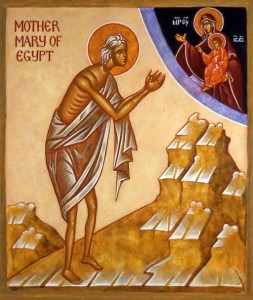
Animals, by their type and their actions, are both real actors and symbols within hagiography. What do I mean by ‘real actors’? There were physical creatures who had relationships with saints and were witnessed in behaving in ways not regularly observed for wild animals. St. Zosimas had a lion come help him dig a grave for Mary of Egypt, marking both his sanctity (though he was afraid in the moment) and that of the reposed. Symbolically, animals can be signs or portents of the spiritual realm. For example, when St. Scholastica died, her brother, St. Benedict, saw a dove ascend from her monastic cell and he knew she had reposed. In one of the tales surrounding the life of St. Brigid is one where a poor family came to the saint with their cow who had gone dry inexplicably. She touched the cow and it returned to giving milk, ten times the amount before. This illustrates the providence of God to the poor and the compassion of the saint.
How does this healing between humans and Creation occur? Through asceticism and gratitude. Elizabeth Theokritoff notes, in her book, Living in God’s Creation: Orthodox Perspectives on Ecology, “Asceticism provides the link between our relationship to the material world and our spiritual life. It reveals to us that the way we use material things is absolutely crucial to our spiritual progress.” Fasting, giving alms, denying the passions all have the goal of transfiguring our lives into that which reflects brightly reflects Christ to the world. We rightly place ourselves in the order of Creation through gratitude. Theokritoff continues, “At the basis of that attitude is the understanding of the created world as God’s gift. Not a ‘gift’ in the sense that it is handed over to us to do what we like with; rather, in the sense that it is never ours by right. It entails a constant connection with a Giver, a cause of endless gratitude to one who graciously gives us the enjoyment of what is His own.”
The fruit of this ascetic labor is to return to the original authority structure in Paradise, where our Divine image is restored. Though we are still within the fallen world, glimpses of what this was and will be, are truly transformative. As St. Isaac the Syrian remarks, the mechanics of this renewed relationship is the recognition of the divine, “The moment they catch sight of the humble man their ferocity is tamed; they come up and cling to him as to their Master, wagging their tails and licking his hands and geet. They smell, as coming from that person, the same fragrance that came from Adam before the transgression, the time when they were gathered together before him and he gave them names in paradise. This scent was taken away from us. But Christ has renewed it and given it back to us at his coming.” (Homily 77) As with all relationships, animals also retain a choice as to whether they will engage with us. They may cooperate or choose to cohabit with us or keep to their regular life in the wild. The humble man removes the barriers for this choice.
St. Nektary of Optina said, “St. Gerasimus was a great saint and he cared for a lion. We are little so we have cats.” We all have little ways to pursue gentleness with God’s creation. How have you seen wild animals react to patient love and humility? How can we better cultivate relationships with the small living creatures and the great?
…….
Read more about St. Melangell in this excellent article from Road to Emmaus.
More quotes from the Church Fathers regarding our relationship with Creation.
 Annamarie Neill